
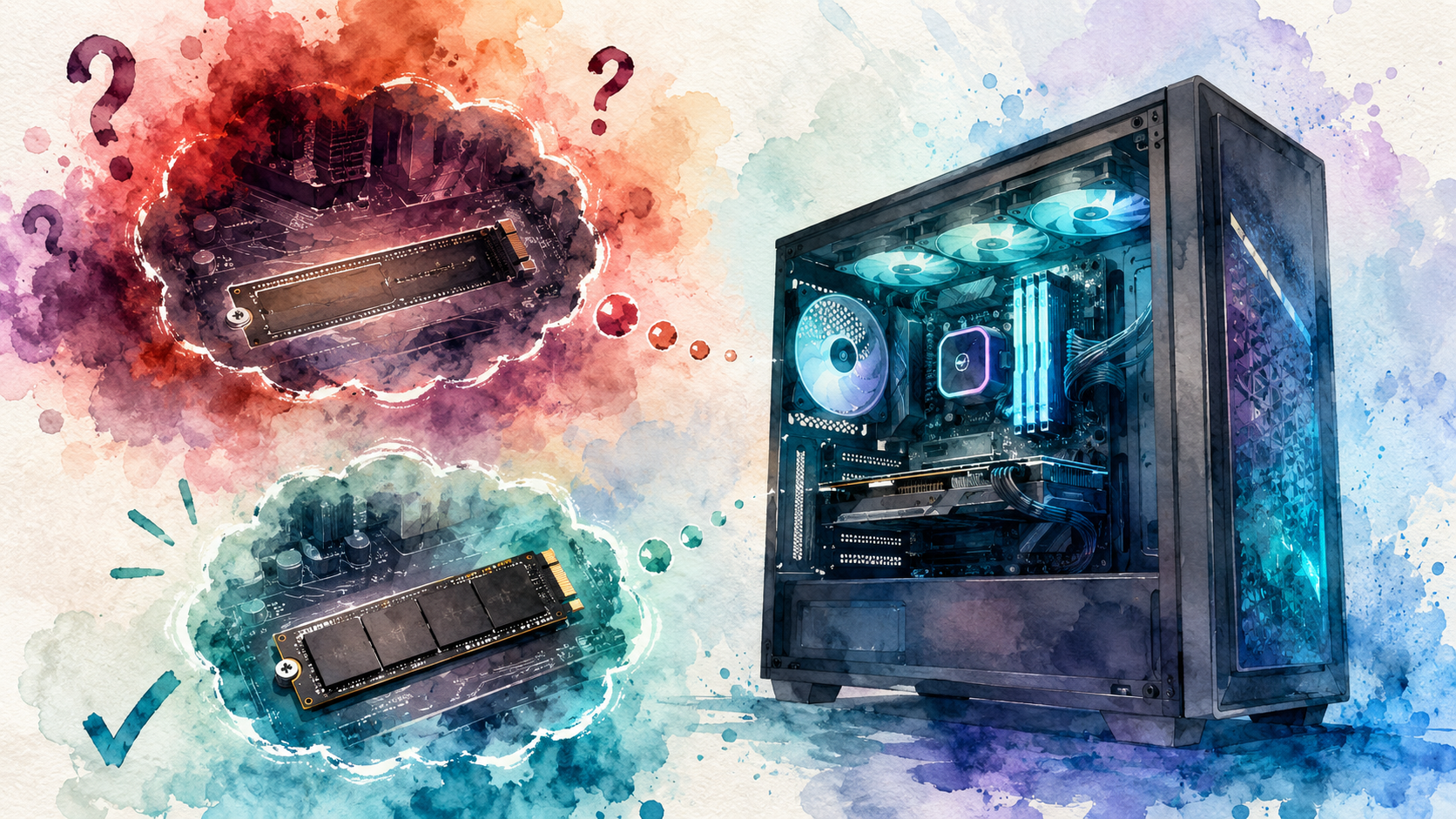
A PC with no storage can make perfect sense when you’re looking at the numbers.
You save another fifteen to thirty pounds. The build cost stays tighter. You can tell yourself the buyer might already have a drive, or that adding one later is easy enough.
On paper, that’s all true.
The problem is that buyers are not looking at your build the way you’re looking at your margin sheet.
They’re not only asking whether the PC has storage.
They’re asking themselves whether this looks like a finished machine they can trust.
That’s where missing storage starts to hurt.
Buyers do not separate your cost logic from their risk logic
As the seller, you might see missing storage as a sensible place to save money.
The buyer may see it as a warning sign.
Your internal logic is straightforward enough: they can add their own SSD.
But the buyer’s reaction is often much simpler than that: why did they stop here?
Once that thought creeps in, people start looking for other reasons to doubt the build.
No storage can make them wonder:
- Has Windows been tested properly?
- Has the system been stress tested?
- Is anything else missing?
- Is this a finished PC or a parts bundle?
- Am I going to have to troubleshoot this myself?
Even if everything else is fine, the listing now has to fight uncertainty.
And uncertainty usually means softer offers.
Confidence is part of the product
When people buy a used PC, they’re not only buying the CPU, GPU, RAM, and case.
They’re buying confidence.
They want to feel like the machine turns on, boots cleanly, behaves normally, and won’t become their problem ten minutes after they get it home.
A simple boot drive helps tell that story.
It lets the buyer picture something easy: take it home, plug it in, use it.
That picture matters more than people think.
A PC with no drive makes the buyer imagine extra steps. A PC with even a modest SSD makes it feel more like something ready to own.
That changes the tone of the whole listing.
A cheap SSD can make the whole listing feel more complete
You don’t always need a large drive.
For a lot of budget flips, even a modest SATA SSD changes how complete the system feels.
A small boot SSD lets you say things like:
- boots to Windows
- tested and ready
- clean install
- usable out of the box
- easy to upgrade later
That’s a much stronger story than saying no storage included.
That line may be honest, but it also creates friction straight away.
Now the buyer is thinking about finding a drive, installing it, loading Windows, checking drivers, and hoping nothing else is wrong.
Most people aren’t trying to buy a project. They’re trying to buy a working PC.
Storage changes the comparison set
This is the bit that’s easy to miss.
A build without storage often isn’t being compared with other almost-finished builds.
It’s being compared with fully working systems.
So the buyer isn’t just subtracting the cost of a drive. They’re subtracting the time, effort, and uncertainty that comes with finishing the job themselves.
That’s why a used SSD that only costs twenty pounds can still drag the perceived value down by more than twenty pounds.
They’re not pricing the part. They’re pricing the hassle.
Where missing storage is acceptable
There are still times when leaving storage out makes sense.
For example:
- you are selling clearly as a barebones system
- the buyer is technical and expects to add their own drive
- the build is being sold as parts rather than ready-to-game
- the local market is extremely price-sensitive
- storage would push the build above a key price bracket
In those cases, leaving storage out isn’t automatically a mistake.
But you do need to frame it properly.
Something like “No storage included, tested with a known-good SSD” is much better than letting the buyer discover the gap halfway through the listing.
Where it can backfire
Missing storage hurts most when the rest of the listing is trying hard to look ready to use.
For example:
- RGB case
- clean photos
- gaming PC wording
- tested or working claims
- complete build pricing
- beginner-friendly buyer target
If the listing looks like a finished gaming PC but has no boot drive, the buyer gets mixed signals.
The photos say ready.
The spec says not quite.
That’s where confidence starts to drop.
The better approach
For most budget flips, the goal isn’t to fit the biggest SSD you can justify.
It’s to remove doubt as cheaply as you can.
A sensible approach usually looks like this:
- add a basic SATA SSD or NVMe drive if the board supports it
- make sure the system boots cleanly
- install a clean OS where appropriate
- include storage clearly in the listing title and spec
- mention that larger storage can be added later
That keeps the build practical without letting storage eat the margin.
The real lesson
Missing storage isn’t just a missing component.
It’s a missing trust signal.
A cheap SSD does more than hold files. It tells the buyer the PC has been finished, tested, and properly prepared.
That’s why storage can matter more than its raw cost.
The SSD isn’t really the upgrade.
The real upgrade is removing doubt.